Field guide · A framework
The Levels of AI-Assisted Engineering.
Building with AI has quietly turned into reviewing everything a dozen agents write. Nobody signed up for that. It helps to name where you actually are, so here is the ladder, rung by rung.
Fleet engineering is the practice of running goal-driven fleets of coding agents: the system writes the loops, manages the agents, and verifies the work, and a human approves outcomes. It is the top rung of this ladder, and this page is the durable home of both the term and the map.
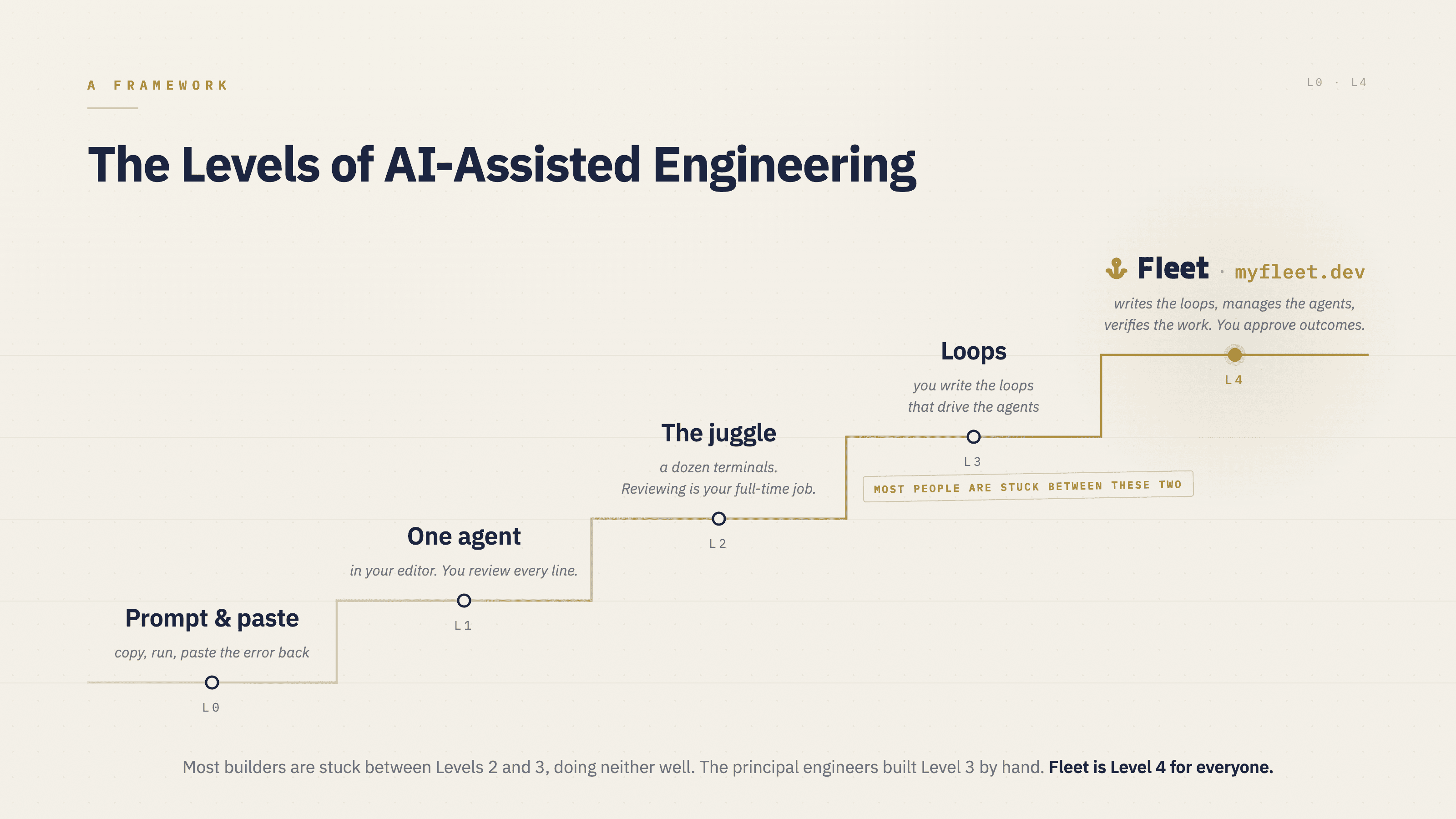
The whole ladder in one image, sized to pass along.
L0
Prompt & paste
Chat on one side, editor on the other. Copy, run, paste the error back.
Everyone starts here. The model helps, but your workflow hasn't changed at all.
L1
One agent
It lives in your editor, sees your project, writes real code. You review every line.
This is where most of the industry lives today. The agent is real help, and you are still the gate on every change.
L2
The juggle
A dozen terminals of agents, and reviewing them is now your full-time job.
More agents looked like the obvious next step. The review load grows faster than the output does.
L3
Loops
You engineer the context, the harness, the loops that drive the agents. Running that machine is your new job.
This rung works, and it is expensive. The principal engineers who reached it built their harnesses by hand, over months.
L4
Fleet
You state a goal. The fleet writes the loops, manages the agents, verifies the work, proves it's done. You approve outcomes.
The system runs the machine; you set its direction. Fleet exists to make this rung a download.
The diagnosis
Stuck between two rungs.
Most serious builders are stuck somewhere between Level 2 and Level 3: juggling more agents than they can review, wiring up loops they never quite finish. Doing neither well. The principal engineers built Level 3 for real, by hand, and almost nobody else has the months that takes.
Most builders are stuck between Levels 2 and 3, doing neither well. The principal engineers built Level 3 by hand. Fleet is Level 4 for everyone.
Concept
The reviewer's ceiling
Your output is capped by how much AI code you can review without losing your mind. That cap is the reviewer's ceiling, and it is what pins you at Level 2. Adding agents raises the amount of code written; it does nothing for the amount you can trust. Past the ceiling, every extra agent just deepens the pile waiting on you.
Concept
Proof-gated work
Nothing is done until it's proven, not claimed. Proof-gated work ships with the receipt attached: the passing build, the test run, the screenshot, checked before a human ever looks. This is what breaks the reviewer's ceiling, because you stop re-reading everything the agents wrote and start approving outcomes that carry their own evidence.
In Fleet that gate is a code path, documented in how the proof gate is enforced, claim by claim.
The top rung
Fleet is Level 4, as a Mac app.
An AI captain runs a crew of Claude Code workers from goal to shipped, with proof at the gate. See how it works.