AI captain.  Real engineers.  Real results.

Give it a goal, not a prompt.

Fleet runs a crew of AI engineers on your Mac, and it doesn't stop until it's finished, and proven.

macOS 14.0+  ·  Apple Silicon  ·  $0 API fees

Last shipped yesterday34 changes this week, every one verifiedFleet builds Fleet: read the ship's log →
Fleet turning a plain-English goal into a verified draft PR: proof verified

The real bottleneck

Writing code isn't the bottleneck.
Reviewing it is.

A dozen agent tabs, every diff yours to check: your review capacity is the ceiling. Fleet flips it: you review proven work, not raw diffs.

“What is this session even doing?”

One Captain, not a dozen tabs

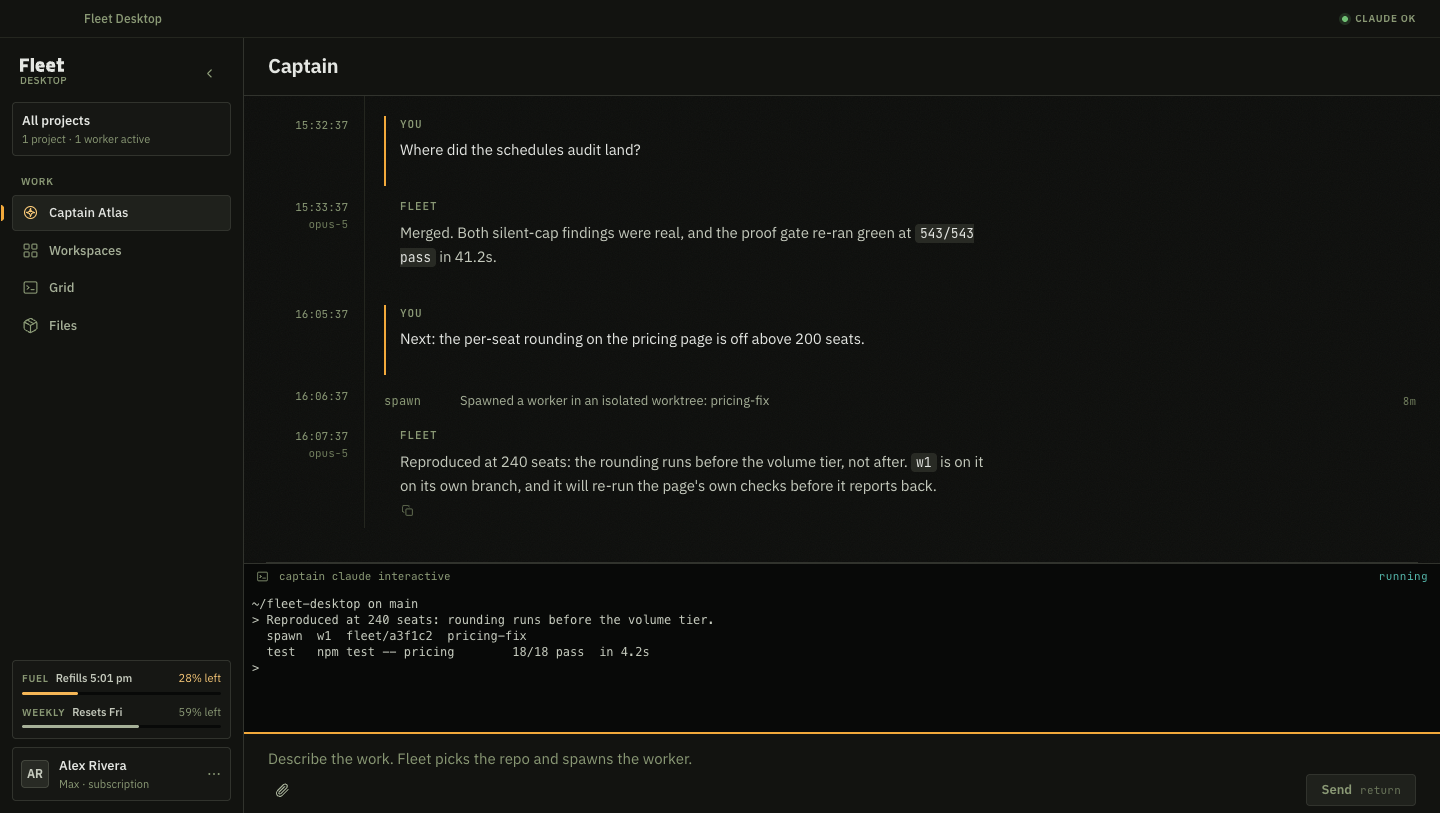
Brain-dump the goal to one Captain. It plans, routes, and steers the whole crew.

“How much AI code can I sanely review?”

Verified before it reaches you

A different model adversarially checks every job (compiled, tested, screenshotted) before you see it.

“It ran all night and built the wrong thing.”

On-goal, with a human gate

The Captain keeps every worker on the goal; risky calls wait for your OK.

Your review queue
PR #214booking flowproof ✓PR #209rate limitsproof ✓PR #221release notesproof ✓

Meet the fleet

One captain. A whole crew.
You just give the goal.

The Captain is a Claude: your chief of staff, surfacing only the calls that need you.

The Captain runs the crew

It takes your goal, plans the work, designs the checks that will prove it, dispatches workers, and judges what comes back. You direct like a boss, not a programmer.

▸ goal     “build the booking flow and ship it”
▸ plan    4 tasks · proof checks designed · 1 needs your OK
▸ crew    W1 schema · W2 UI · W3 payments · W4 tests
▸ judge   W2 returned · proof attached ✓

Live steering

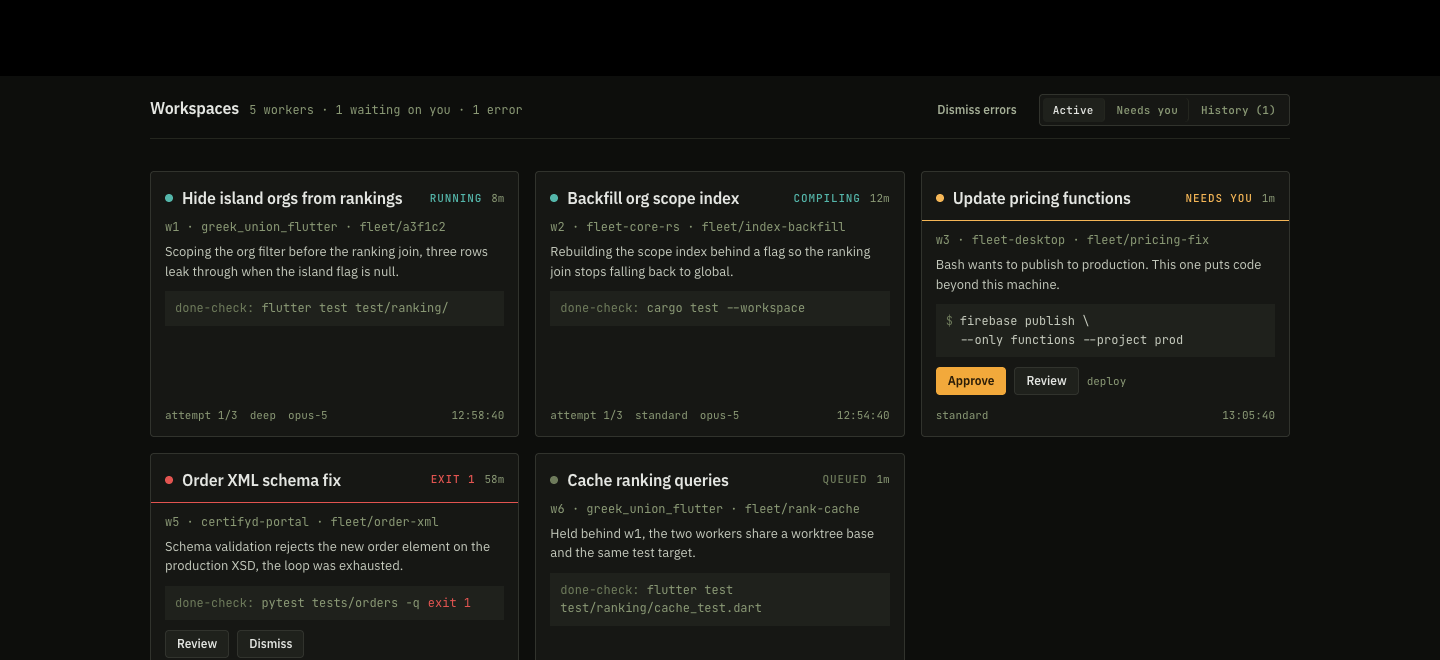
Every worker is visible and steerable mid-job. Redirect it without restarting.

→ use the staging API, not prod
sent to W2 · picked up mid-task

Workers in parallel

Several jobs at once, across your whole product, each one a full Claude Code session.

W2 · Billing usage tiersRunning
cargo test: 214 passed · committing to its branch…

Isolated worktrees

Every job builds on its own branch, in its own worktree. Main is never touched until you approve.

main · protected
└─ fleet/w2-booking-ui
└─ fleet/w4-payment-tests

Nothing risky without your OK

Migrations, deploys, deletions: the Captain brings the big calls to you first.

W3 wants to run a DB migrationApproveHold

The proof gate

Done means proven.

Nothing counts as done until the worker proves it: tests run, screenshots captured. Fail, and the Captain loops it back. That proof-loop is the difference between started and shipped.

See the whole loop
done-check · W4 · API rate limits
$ fleet verify w4
▸ pytest ············ 41 passed
▸ next build ········ exit 0
▸ screenshot ········ captured ✓
▸ curl /api/limits ·· 429 after 100 req ✓
PROOF VERIFIED · draft PR #214 ready for your review

The loop

Engineering runs in loops.

Plan, build, prove. Around again until its check passes. It's how great engineers ship, and every Fleet worker executes this way, automatically, no re-prompting. Give it a goal and a loop is running in seconds. Nothing leaves until it's proven.

See it run, move by move
goal“build the booking flow”PlanBuildProvefail: go againcheck passesDone. Proven.

Your Mac. Your plan.

Full-power Claude Code, on your existing plan.

Every worker is the real Claude Code, with a cockpit on top instead of a terminal.

Runs on your Mac

Your repos stay local. Your keychain stays yours. No cloud IDE, no code sent off to someone else's sandbox. The crew works where you work.

~/dev/jeevz.com · local
keychain ······· untouched
localhost:3000 · live preview ✓

One flat subscription

Fleet runs on your own Claude plan, so a whole crew working all day costs the same flat price. A metered agent is a taxi meter; your plan is a monthly pass.

$0
API fees, ever
no per-token meter
your flat Claude plan

How it works

From goal to shipped, in five moves.

new goal
build the booking flow and ship itSend →
plain English · outcome included · no prompt engineering

Questions

Straight answers.

It's early, a private beta, and we'll tell you straight.

Is it safe to run on my repos?

Every worker is visible and steerable from the board, and nothing risky happens without your OK: the Captain brings you the calls that matter (migrations, deploys, deletions) before they run. Workers build in isolated git worktrees, so main is never touched until you approve the merge.

What does it cost?

Fleet drives the official Claude Code on your own flat Claude plan, so a whole crew working all day costs the same monthly price: $0 in API fees, no per-token meter. A metered agent is a taxi meter; your plan is a monthly pass. And it isn't against Claude's terms: it's the official CLI, on your own subscription, used the way it's designed.

Which models does it use?

The real ones. Every worker is a full Claude Code session, the same tool developers run in their terminals, so you get the full Claude models and Claude Code's whole toolkit, not a stripped-down API wrapper.

Do I need to know git worktrees?

No. The Captain creates and cleans up an isolated worktree for every job automatically. You give goals in plain English; the branching, isolation, and merging are its problem.

How is this different from Claude Code alone?

Claude Code can spawn subagents, but a raw subagent is a black box: invisible, unsteerable, and “done” with nothing proving it. Spawning agents is a capability; running a fleet is an operation: visible workers, a human gate, and nothing marked done until it's proven.

Private beta

Don't just start it.Finish it.

You've got a backlog of things you want built and shipped. Fleet is the crew that finishes them: proven, not claimed.

macOS 14.0+  ·  Apple Silicon  ·  $0 API fees